
Does your child struggle to hear or follow instructions in class — even with normal hearing tests?
They might be facing more than just “not paying attention.” Many students with Auditory Processing Disorder (APD), Autism Spectrum Disorder (ASD), or abnormal hearing struggle to hear clearly in noisy classrooms. This isn’t just frustrating — it can affect their learning, confidence, and social interaction.
Let’s explore how improving the signal-to-noise ratio (SNR) can help — and how devices like Roger™ microphones can make a big difference.
Imagine trying to hear a teacher’s voice over the hum of fans, other students talking, or scraping chairs. For most of us, our brains can filter out background noise. But for students with APD, ASD, or mild hearing loss, this can be overwhelming.
Signal-to-noise ratio simply means how loud the important sound (like the teacher’s voice) is compared to the background noise.
The higher the SNR, the easier it is to understand what’s being said.
Children with APD: Their ears can hear, but their brains have difficulty making sense of sounds — especially in noisy environments.
Children with ASD: Many experience sensory sensitivities and may find background noise extremely distracting or upsetting.
Children with mild or undiagnosed hearing loss: They may not qualify for hearing aids, but still struggle in noisy classrooms.
One of the best ways to improve SNR is by using wireless microphone systems like Phonak Roger™.
How it works:
The teacher wears a small microphone.
The student wears hearing aids or a receiver connected to the Roger system.
The teacher’s voice is sent directly to the student’s ears, cutting through the background noise.
Benefits:
✅ Helps the student hear better — even from the back of the class
✅ Reduces listening effort and fatigue
✅ Improves focus, academic performance, and confidence
✅ Supports inclusive learning for children with special needs

Hearing loss doesn’t always begin with total silence. Often, it sneaks up gradually, affecting clarity rather than volume. You might hear people speaking but struggle to understand what they’re saying — especially in background noise. If any of the following signs sound familiar, it may be time for a professional hearing evaluation.
In busy places like coffee shops, family dinners, or MRT stations, you may find it difficult to follow conversations — especially if multiple people are speaking at once. This difficulty with background noise is often one of the earliest signs of hearing loss.
If you often feel that others are not speaking clearly, the issue may lie with your hearing, not their speech. High-frequency hearing loss affects your ability to hear consonants like “s,” “f,” and “th,” making speech seem muffled.
It might feel like you’re asking “Sorry?” or “What was that?” more often — particularly on the phone or during meetings. This can affect your confidence and make socialising exhausting.
Family members or roommates complaining about volume levels can be a clue. Needing to increase the volume often indicates reduced sensitivity to certain sound ranges.
Some people unconsciously withdraw from conversations or gatherings due to embarrassment or frustration. Social withdrawal is a major quality-of-life concern and can lead to depression or loneliness.
Getting your hearing tested is easy, painless, and non-invasive. At Hear Again, we conduct comprehensive audiological evaluations in a quiet, clinical environment using international best practices. Your results are discussed in detail, and we only recommend treatment when it’s truly needed — no sales pressure, just honest, professional advice.
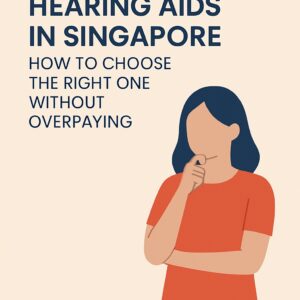
Hearing aids are transformative tools that restore not just hearing, but also confidence, connection, and quality of life. However, many people in Singapore are overwhelmed by the choices available and the wide range of prices — from $1,000 to over $6,000 per ear. So how do you make the right decision without overpaying?
Choosing a hearing aid should start with a professional hearing assessment. No two people have the same hearing profile or listening needs. An office executive may need sophisticated noise filtering for meetings, while a retiree may prioritise clarity during TV time or family chats.
At Hear Again, we:
Conduct a detailed audiogram and lifestyle needs assessment
Explain your hearing loss in simple terms
Match your needs with appropriate technology — no upselling
Hearing aids come in several styles and performance levels:
Behind-the-Ear (BTE): Powerful and comfortable; suitable for most hearing losses
Receiver-in-Canal (RIC): Discreet and widely used
In-the-Ear (ITE) or Completely-in-Canal (CIC): Almost invisible, but may not suit severe losses
Technology-wise, modern digital aids offer features like:
Directional microphones to focus on speech
Feedback suppression (no whistling)
Bluetooth connectivity (stream calls/music)
AI learning (adapts to your environment over time)
The hearing aid is only as good as its fitting. At Hear Again, we use Real Ear Measurement (REM) and Speech Mapping to calibrate your hearing aids based on how sound actually behaves in your ears. This ensures:
Better speech clarity
Less need for frequent adjustments
A more natural, comfortable hearing experience
Unlike retail outlets, our clinic prioritises clinical outcomes over commissions. Because we are audiologist-run, we offer:
Lower prices
Unbiased brand selection (Phonak, Signia, ReSound, Cochlear)
Follow-up support and fine-tuning included
The right hearing aid doesn’t have to be the most expensive. It should be the most effective — for you.

Hearing loss doesn’t usually happen overnight. It progresses gradually, making it easy to overlook early signs. Many people in Singapore—and globally—live with undiagnosed hearing loss for years. According to research, the average delay between the onset of hearing loss and seeking help is around 7 to 10 years. Unfortunately, during this time, the condition may worsen and negatively affect quality of life.
When left untreated, hearing loss can impact many aspects of daily living:
Communication breakdown: You may find it harder to follow conversations, especially in noisy environments like hawker centres, MRT stations, or social events.
Social isolation: Difficulty hearing often leads to avoiding group conversations or family gatherings, which can result in loneliness.
Mental fatigue: The brain works harder to understand muffled sounds, leading to exhaustion and irritability.
Cognitive decline: Studies, including those by Johns Hopkins University and The Lancet Commission, show a link between hearing loss and an increased risk of dementia and Alzheimer’s disease.
Detecting hearing loss early allows for proactive intervention, which can:
Prevent further deterioration
Preserve your ability to understand speech clearly
Improve personal and professional relationships
Enhance emotional wellbeing
Reduce your risk of cognitive decline
Singapore’s healthcare system offers easy access to hearing care, yet many people still wait until their symptoms are severe. At Hear Again, we recommend baseline hearing checks starting at age 50, or earlier if you:
Have a family history of hearing loss
Are frequently exposed to loud environments
Struggle to follow conversations
Feel tired or frustrated during social interactions
A hearing assessment at Hear Again is safe, painless, and informative. It typically includes:
Medical and lifestyle history review
Ear examination to check for wax or infection
Audiometry to measure your hearing thresholds
Speech testing in quiet and noisy settings
A consultation to discuss results and possible solutions
The goal is not just to detect hearing loss, but to understand how it affects your life and how we can help you hear better.
Many people worry about the cost of hearing aids or fear being sold something they don’t need. That’s why Hear Again operates differently. As an audiologist-run clinic, we are focused on professional care, not sales. Our approach is about guiding you with transparency, empathy, and facts.
We offer affordable hearing solutions tailored to your lifestyle and budget — with no pressure. Whether it’s a simple check-up or advanced diagnostic support, early action makes all the difference.

We are aware of the recent disruptions caused by the Change Healthcare cybersecurity incident and understand the impact it may have had on our valued members and partners.
At [Your Organization Name], your security and continued access to healthcare services are our top priorities. We are actively working with our partners to monitor the situation, ensure minimal disruption, and support any members who may be affected by delays or outages resulting from this incident.
No action is needed from your side at this time unless you’ve been directly contacted.
All our systems remain secure and operational.
We’re taking extra precautions to protect member information and ensure data integrity.
If you’re experiencing issues related to billing, prescriptions, or provider communications, please don’t hesitate to contact our support team. We’re here to help resolve any concerns and provide updates as more information becomes available from Change Healthcare.
We are aware of the recent disruptions caused by the Change Healthcare cybersecurity incident and understand the impact it may have had on our valued members and partners.
At [Your Organization Name], your security and continued access to healthcare services are our top priorities. We are actively working with our partners to monitor the situation, ensure minimal disruption, and support any members who may be affected by delays or outages resulting from this incident.
No action is needed from your side at this time unless you’ve been directly contacted.
All our systems remain secure and operational.
We’re taking extra precautions to protect member information and ensure data integrity.
If you’re experiencing issues related to billing, prescriptions, or provider communications, please don’t hesitate to contact our support team. We’re here to help resolve any concerns and provide updates as more information becomes available from Change Healthcare.